Wild garlic is one of the first markers that spring has arrived. Vibrant green shoots spring from the earth in dense stands, eventually growing tiny flushes of purple and white flowers that sit atop narrow stalks. The flowers don’t have the globular pop that some ornamental Allium species have, but the plant makes up for it in flavor. Take a leaf in your hand and gently crush it between your fingers. You should smell the slightly pungent aroma of garlic emanating from the leaves. When foraging, it’s this garlic odor you’re looking for, as it’s the most obvious sign you’ve stumbled across the correct plant.
The genus Allium is home to many of my culinary favorites: onions, leeks, garlic, and scallions, just to name a few. It’s also home to some of my ornamental favorites, with large, architectural blooms that resemble globes or pom-poms. It’s a treat to find it wild, but over the years, I have found myself cultivating wild garlic for both its culinary value and its quaint little flower heads.
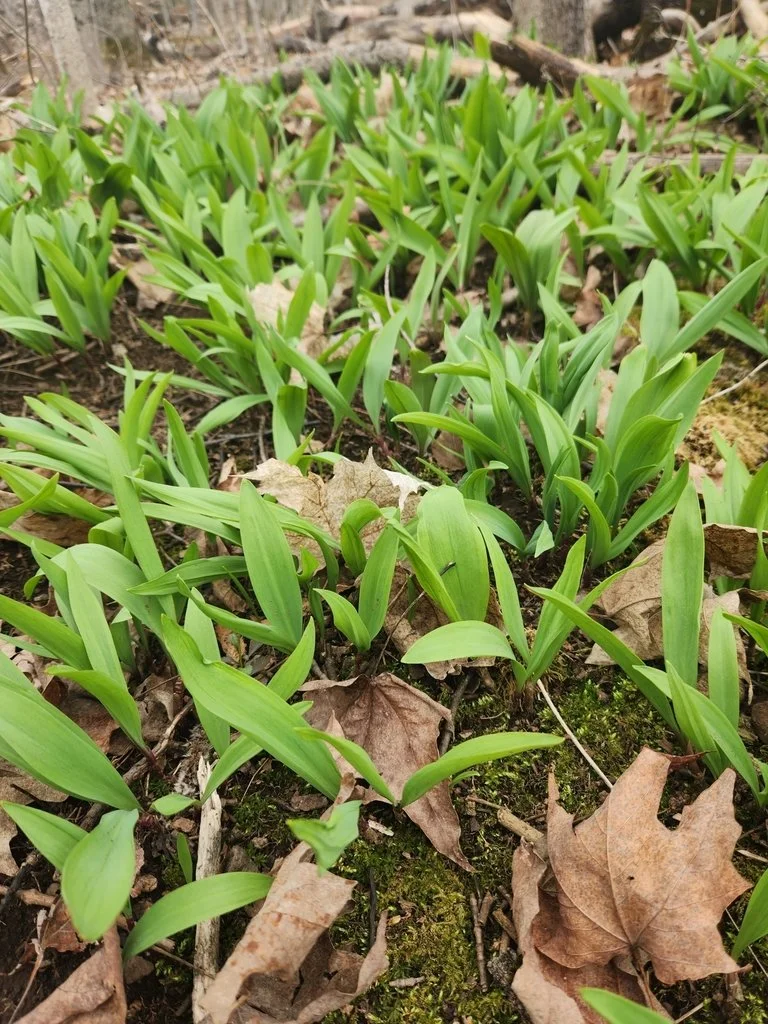
A photo I took of some ramps, or Allium triccocum, growing in a nearby woodland.
What exactly is wild garlic?
Depending on where you live, wild garlic can actually encompass several different plants. In northern Minnesota, wild garlic is typically considered Allium canadense, which is native to this region. However, there’s also field garlic, or Allium vineale, which is also often referred to as wild garlic. These little discrepancies are exactly why using the Latin names for plants is so important! Allium canadense is native, while Allium vineale is introduced - and many states actually consider the latter species to be a noxious weed (although, Allium canadense has also spread beyond its native range and is considered a noxious weed in some states).
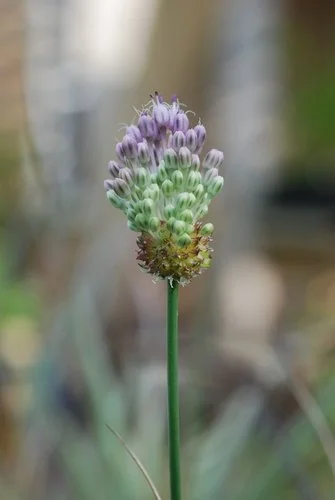
Allium vineale, courtesy of iNaturalist
Allium vineale is present in Minnesota, although primarily in the southern half of the state. This species has an interesting history, as with most introduced plants, it was originally brought here to serve a very useful purpose. Allium vineale was used in early European ships as ‘ballast,’ or a material that serves to balance the ship’s center of gravity. Alliums were likely mixed in with soil and rocks. When these ships arrived in the United States, the ballasts were emptied onto the shores, where the plants took hold and began to spread.
Wild garlic (also known as wild onion) is a member of the amaryllis family, which is primarily a group of bulbous plants. They go dormant during the winter time, have basal leaves (emerge from the bulb), and umbel flowers situated on an upright stalk. Wild garlic belongs in the subfamily Allioideae, which is a family of plants who have the characteristic onion or garlic smell when crushed.
Oof. That’s enough botany.
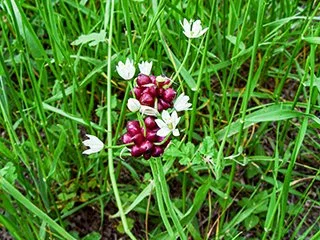
Allium canadense, courtesy of Minnesota Wildflowers
Benefits of Wild Garlic
Wild garlic has been used for centuries. These plants were used by indigenous peoples across the United States. Introduced species, such as Allium vineale, was used by early Europeans for centuries. It was primarily foraged for culinary purposes, growing during a time where fresh food stores were running low. The advent of early spring Alliums provided much needed nourishment during the transitionary period between late winter and spring.
Garlic also has medicinal value. Wild garlic species have been studied less than garden-grown garlic, Allium sativum, and while I was able to find some studies related to the latter, wild garlic appears to be an under-studied plant. Research showed that a European wild garlic, Allium ursinum, had strong antioxidant and antimicrobial benefits (NIH). In fact, many of the benefits were similar to cultivated garlic, such as protecting cardiovascular health, reducing blood pressure, and some protections against cancer. However, the dosage needed from wild garlic was inconsistent and needed to be higher than that of cultivated garlic. In short, like other Allium species, Allium ursinum proves to have some medicinal benefits, but the research is ongoing.
The waters get even muddier when we consider that the benefits may be present in one species and lacking in another. The study cited above mentioned that wild garlic harvested in different areas or at different times of the year had varying levels of helpful compounds. It can then be inferred that a different species growing on a continent one gigantic ocean away may lack benefits - or, who knows, maybe Allium canadense is rife with cardiovascular benefits we just haven’t realized yet.
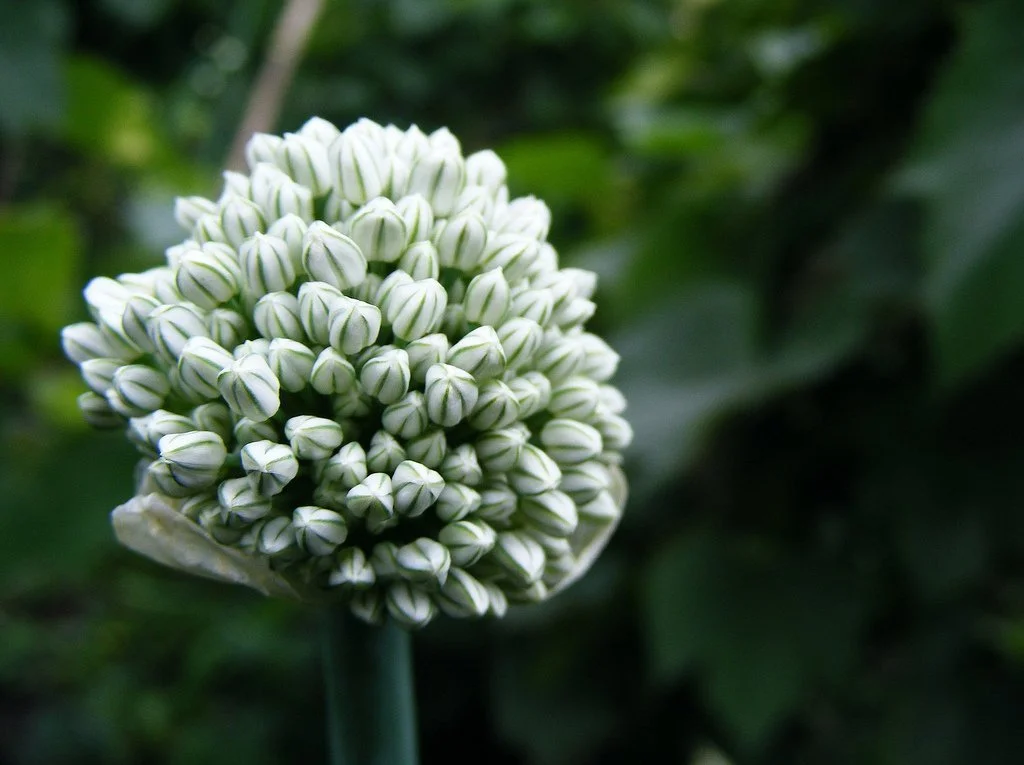
Allium sativum, courtesy of Cambridge University Botanic Garden
Wild Garlic Folklore
Early Europeans would often call wild garlic “ramsey,” derived from the old English word hramsa, which means “garlic.” Much of the folklore is steeped around Allium ursinum specifically, which was found growing in England, Ireland, and Scotland. What I find fascinating about etymology, or the study of the origin and history of words, is that we can trace a plant’s story through its common name. For example, there are some English towns and cities whose names are derived from hramsa, two such examples are Ramsey and Ramsbottom. There are quite a few in Ireland, whose word for wild garlic originated from creamh. Wild garlic was such an important plant that entire villages can trace it to their namesake.
Some of wild garlic’s folklore is tied with Allium sativum’s (cultivated garlic’s). Once early people encountered wild-growing Alliums that smelled and tasted like their known, cultivated garlic, it isn’t surprising that some of the same associations followed the plant. Because of its pungent odor, garlic was believed to have the ability to ward off evil spirits and protect against the evil eye. Wild garlic’s ability to repel made it a strong candidate for warding off negative entities and its pungency meant it was symbolically powerful medicine.
The household was often a symbol of a threshold between known and unknown, safety and risk. Wild garlic was hung over doors, windows, or even blocked keyholes. Its protective qualities meant that hanging a satchel of wild garlic above a home’s door or weaving them into thatched roofs would bring good luck and provide protection from dark energies. Small sachets of wild garlic were also carried to prevent curses or to ward off the evil eye. In general, protective garlic traditions overlap with broader European beliefs about pungent or strongly scented plants.
Cultivated garlic’s magical properties can be traced back to the ancient Greeks and Romans, who used garlic for its culinary and protective powers. Romans would decorate their homes with pictures of the plant, which were later found in excavations of Pompeii. Garlic would be placed under the pillows of infants or rubbed on pregnant women and virgins as protections against witches and fairies. (Dugan, F. M).
Witches, apparently, detested the odor of garlic and could be thwarted from their craft (or from cannibalism) by consuming, wearing, or decorating homes with garlic. Christmas and Easter were particularly perilous times for Christians who feared the witch. Garlic was rubbed on children’s skin and even worn to church during this period, as witches were thought to cannibalize unguarded Christians during these celebrations. Another interesting protection was to turn a broom upside down behind the door as a means to ward off witches. (Dugan, F.M.).
Moving now to Northern Europe, garlic was often worn as a talisman in Anglo-Saxon tradition, in order to protect against nightmares and witches. Garlic could be worn as protection against the walking dead on All Hallows Eve. As with the Romans, people living in the British Isles would use garlic to protect infants. In early Germanic and Nordic beliefs, garlic as well as scissors or knives, would be placed in the infant’s cradle to deter harmful fairies. (Dugan, F.M.).

Infant wrapped in garlic cloves. Photo courtesy of Frank M. Dugan, Seldom Just Food: Garlic in Magic and Medicine in European and Mediterranean Traditions.
In North America, the garlic tradition survived. It was used against witchcraft and to protect against the evil eye. It could be worn as an amulet or carried as cloves.
We still instinctively recognize garlic’s smell as strong, penetrating, something that can’t be missed. The medieval person and the modern gardener are experiencing the same basic plant traits, even if today we’ve assigned it very different meanings.
In Conclusion
Wild garlic species can be fun to forage and can add a bit of flavor to your springtime dishes. The pungent leaves make wild garlic an easier plant to identify for beginner foragers, and the small purple and white flowers dotting meadows, woodland edges, and even roadsides mean that spring is here!
If I’ve learned anything from my exploration into wild garlic, it’s the importance of Latin names. One species is native to northern Minnesota, while another is invasive, but both can serve the same culinary or even medicinal purposes. If researching medicinal benefits, pay attention to which species was studied - just because a plant shares the same Genus (Allium) it doesn’t mean that the benefits translate across all species. To be fair, Alliums comprises a huge number of species, which can make researching plants in this genus a bit more complex.
It’s also fair to recognize garlic’s protective qualities. Don’t worry - I won’t be rubbing it on my skin or wearing garlic talismans, but the NIH did mention medicinally beneficial uses of consuming garlic. In that case, I’ll continue to add more garlic than the recipe requires because you can never add too much, right?! This spring, I’ll be happy to toss in some wild garlic and ramps to spring dishes to add some flavor, and perhaps, for a bit of protection and good luck.
Further Reading
Growing Cultivated Garlic in Minnesota
Provided by the University of Minnesota Extension. Just about everything you could ever want to know about growing garlic.
Allium canadense information and seeds/plants for purchase
This link will take you to Prairie Moon, one of my favorite places to purchase native plants. This is a Minnesota based company but ships nationwide. Look closely to see the native range for any garlic species you want to grow.
This will take you to Minnesota Wildflowers. Before foraging for any wild garlic, make sure you can confidently identify the plant.
The internet is rife with plant folklore websites and I found a lot of shared misinformation. This academic essay is well-researched and a great source of legitimate information!